App-enabled Sports Technology that Help You Improve Your Game in Baseball, Golf and Basketball
I bet it sounds more like a perfect way out, more like a cheat but does it really work?
Experts are always working on things to make it interesting, easier and better and they are gradually getting it into sports by the minute. The
tech world’s current obsession is with wearables — the idea being that
you can stuff all manner of technology into increasingly tiny packages.
So far, much of the attention has been on watches and glasses. But the
same teeny sensors and smartphone brains that power those devices have
other applications, too — for instance, in a new wave of smart sports
equipment.
In
the last year, companies have started to introduce some intriguing
sports devices that analyze movement using sensors, in particular
multi-axis accelerometers (for measuring linear acceleration) and
gyroscopes (for measuring orientation). The point of all these gadgets,
in essence, is to put a digital coach into your pocket. Yes! a technology that teaches you how to swing or throw, here are some of this technologies in action >>>> Click here to watch the video
A Brief on some of this insanely interesting technologies and how they are designed to make play better
 The Swingbyt is a $150 plastic doodad about the size of a jumbo pack of
Juicy Fruit that breaks down your golf swing. The original version had a
glorified rubber band that helped attach the device to a club, but
Version 2.0 — new to market — has an intricate latch that has a
theoretically tighter grasp. Then when you swing the club, the device
sends data by Bluetooth to your tablet or smartphone, where an app
collects the data and spits back a pile of information and analysis that
means something to people who understand things like face angle and
swing path.
The Swingbyt is a $150 plastic doodad about the size of a jumbo pack of
Juicy Fruit that breaks down your golf swing. The original version had a
glorified rubber band that helped attach the device to a club, but
Version 2.0 — new to market — has an intricate latch that has a
theoretically tighter grasp. Then when you swing the club, the device
sends data by Bluetooth to your tablet or smartphone, where an app
collects the data and spits back a pile of information and analysis that
means something to people who understand things like face angle and
swing path.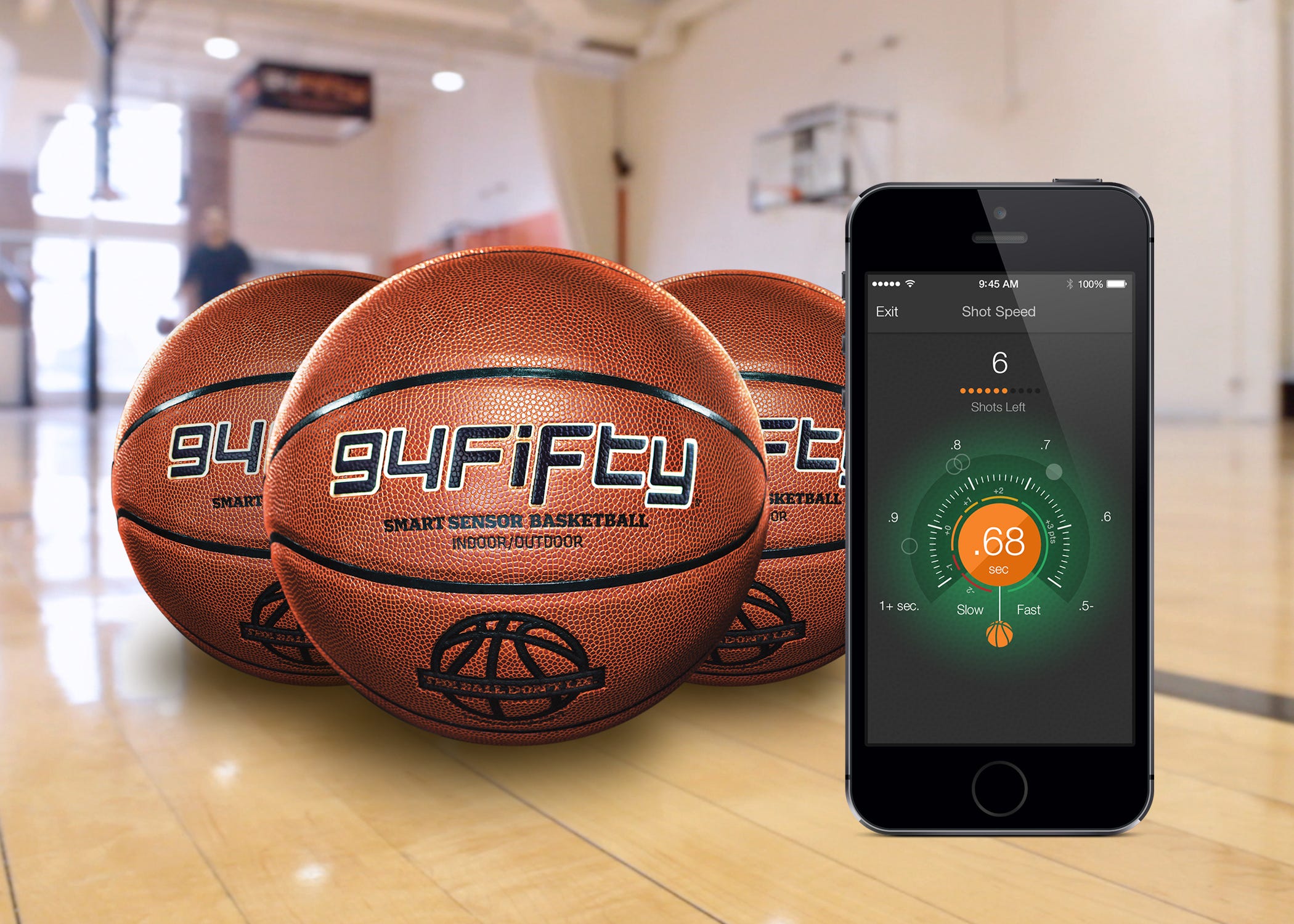 94Fifty,
a $300 app-enabled basketball that you can buy at the Apple Store. The
94Fifty is an impressive piece of technology: It is a regulation
basketball with a built-in suite of sensors that, like the Swingbyte,
transmits data in real time to an app. It also recharges wirelessly.
94Fifty,
a $300 app-enabled basketball that you can buy at the Apple Store. The
94Fifty is an impressive piece of technology: It is a regulation
basketball with a built-in suite of sensors that, like the Swingbyte,
transmits data in real time to an app. It also recharges wirelessly.
The
94Fifty focuses on two primary skills, dribbling and shooting and
the accompanying app, as slick and simple as Swingbyte’s, presents a
series of drills and games to work on these. Once data is captured and
transmitted (every 100 milliseconds, Mr. Crowley said), the user’s
skills are compared against a baseline of “good” form taken from tens of
thousands of players around the world.
What
the 94Fifty tries to do is show which skills are lacking, and then help
elevate those skills — by encouraging faster dribbling, for example, or
more backspin on a shot.

Zepp, a $150 fluorescent-green square that snaps into one of three rubber mounts for golf clubs, tennis rackets and baseball bats. As with the other two devices, Zepp’s app is well-designed and nice to
look at, with a simple interface and all the swipes and pull-downs we
smartphone users are accustomed to. The generated data are easy to understand with supports on how to swing it better.
For
that reason, all three apps allow you to email the results to a coach,
or share them via social media, if you just feel like letting others
know you can swing a bat (barely) faster than a 12-year-old. Once you
know what good form looks and feels like, you can use the devices on
your own to develop muscle memory through repetition. An obvious next
step for all of these products is to incorporate instruction as well.
Swingbyte and 94Fifty are simple and
easily fixed, but they hinted at an obvious limitation of pretty much
all brand-new technology: New technologies rarely works perfectly well, every time,
right out of the gate. So while these off-the-shelf products provide
impressive virtual coaching, they’ll obviously get better with time and
some effort. Just like your game.


Comments
Post a Comment